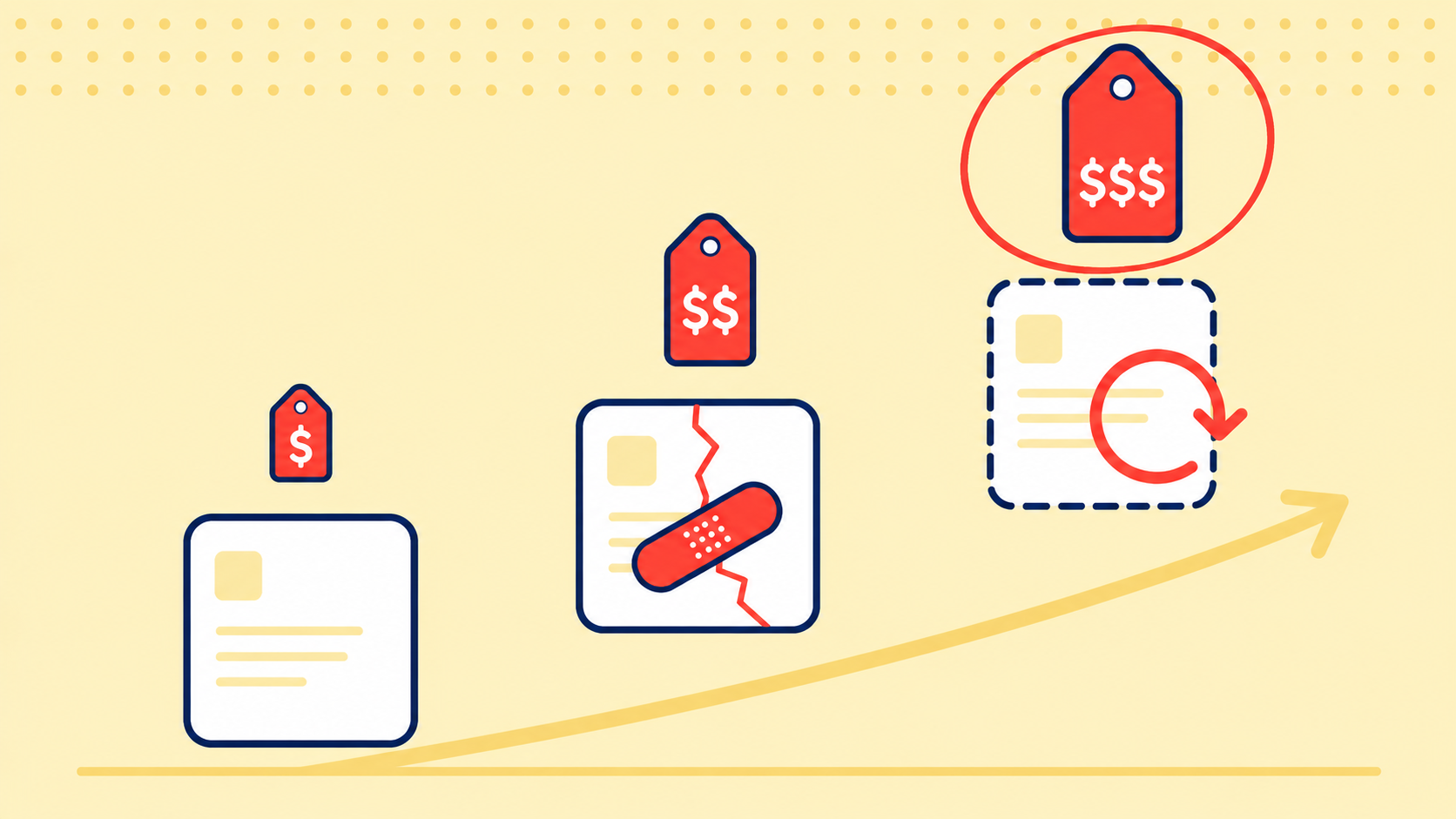
Most MVP rebuilds cost more than getting the first build right because you end up paying three times: once for the cheap initial build, again to patch it as it strains under traction, and a third time to rebuild it properly. Add the months of stalled roadmap and the customers who leave while you are rewriting instead of shipping, and the cheap first build becomes the most expensive path you could have taken.
You shipped in 10 weeks, came in under budget, and the demo worked. 18 months later, you are staring at a quote to build the same product a second time, and the rebuild costs more than everything you spent the first time around. The engineers you have now cannot add a simple feature without three other things breaking, onboarding a new developer takes a month before they touch anything, and every honest conversation about the roadmap starts with “can the current stack even handle this?” The cheap first build did not save you money. It deferred the bill and added interest.
The good news is that the trap is predictable, which means it is avoidable, and the right MVP development services are built specifically to avoid it. This piece walks through the real economics of a rebuild, the founder decisions that make one inevitable, and the specific technical patterns that turn a codebase into something you have to throw away rather than grow.
The Difference Between a Fast MVP and a Cheap MVP
It is worth being clear up front, because this argument gets misread as speed being the enemy. It is the opposite. We have written before about how to build a working product in 60 days, and that framework holds, a disciplined team can put a genuinely working product in front of real users fast. What breaks products is confusing a fast build with a cheap one, where cheap means skipping the architecture, the tests, the data model, and the review discipline that let the product survive its own success.
A fast MVP built right is scoped hard to one hypothesis and engineered so the parts that will obviously grow, the data model, the auth, the core service boundaries, are laid down cleanly even while everything around them stays minimal. A cheap MVP is a scaled-down version of the whole product idea, built by whoever quoted lowest, with every corner cut equally including the ones that become load-bearing the moment you get traction. Both can hit day sixty. Only one of them is still standing at month eighteen. The distinction is the whole game, and it is where a disciplined approach to MVP development earns its keep.
The Real Cost of an MVP Rebuild
Here is the math founders rarely see until they are inside it. The headline number on a rebuild quote is only the first line. Industry breakdowns of startup budgets show that a cheap first MVP routinely leads to a rebuild that costs another full MVP-sized budget, on top of several months of stalled roadmap. So you end up paying three times. Once to build it fast and cheap. Again to patch and duct-tape it through the months where it is visibly straining but you cannot yet justify stopping. Then a third time to rebuild the thing you wish you had built at the start.
The interest compounds the whole way through, because the patching phase is not free either. According to Stripe’s Developer Coefficient report, engineers spend 42% of their working week dealing with technical debt and bad code, 17.3 hours out of a 41.1-hour week. That is nearly half your engineering spend going to fighting the codebase instead of moving the product forward, and it starts well before anyone says the word rebuild out loud. For a small team, that is the difference between shipping the features that win the next round and slipping the quarter.
The reason so many of these situations end in a rebuild rather than a fix is structural. Gartner projects that by 2026, 80% of technical debt will be architectural, the kind that cannot be resolved with simple refactoring because the foundation itself is the problem. Architectural debt does not get patched away. The system has to be rebuilt.
There is also a sunk-cost trap sitting on top of the arithmetic, and it is worth naming because it keeps smart founders patching long past the point it makes sense. The reasoning goes, I already spent this money, I cannot walk away from it now. The honest framing is that the money already spent is gone either way, and the only live question is the cheapest path forward from today. When continuing to fix a fragile build costs nearly as much as a clean rebuild would, and buys you a product that is still fragile at the end, the patching is the expensive option even though it feels like the thrifty one. The technical debt behaves like a loan you did not know you signed for, and the rate is not friendly.
Founder Decisions in Minimum Viable Product Development That Guarantee a Rebuild
Rebuilds are rarely caused by bad engineers. Ask a founder who has been through one what went wrong and they rarely say the code was written badly by incompetent people, they say the decisions upstream of the code were wrong. The single most expensive one is rushing an MVP with the wrong partner. Choosing a freelancer or an agency without real product experience means the build is weeks in before anyone notices they are reinventing auth, billing, and multi-tenancy from scratch, the patterns an experienced team ships from templates in days, and that rework alone commonly runs tens of thousands of dollars and a month or more of slippage before the deeper structural problems even surface.
The second is treating the MVP as a scaled-down version of the full product rather than a test of one hypothesis. When the brief is build everything, just smaller, the team spreads its limited care evenly across twelve features instead of concentrating it on the two that matter and the foundation underneath them. The third is premature optimization in the other direction, teams rewriting the data model in week five for scale that does not exist yet, burning the timeline on theoretical problems while the real one, does anyone actually want this, goes untested. Each of these is a judgment error, and each one raises the odds that the thing you ship will have to be thrown away.
What ties them together is the absence of a product partner who will push back. A team that only writes tickets will build exactly the over-scoped, corner-cut, wrong-shaped thing you asked for. A team that owns the outcome will tell you which of your twelve features to cut, which corners are safe to cut and which are load-bearing, and when you are optimizing for a problem that does not exist yet. That difference is the cheapest insurance against a rebuild you can buy.
Technical Signs Your MVP Needs a Rebuild
Not every struggling codebase needs a full rewrite, and knowing the difference is what separates an expensive panic from a sound decision. Most of the time, the right move is incremental. You wrap the worst modules in tests and replace them one at a time while the product keeps running, an approach engineers call the strangler pattern because the new system grows around the old one until the old one is gone. A full ground-up rewrite is the last resort, justified only when specific patterns show the foundation itself is the problem.
These are the signs that patching has run off-road:
Deep Coupling, Where Everything Is Wired to Everything Else
The first is deep coupling, where everything is wired to everything else so a change in one place breaks another. Fixing a timezone bug breaks cancellations, fixing cancellations breaks the admin panel, and engineers start refusing to touch certain files because nobody can predict the blast radius. When a one-line change is a high-risk operation, and your team spends more time validating regressions than building, the structure itself has failed, and no amount of careful patching fixes a broken structure.
The Absence of Tests on a Codebase Nobody Understands
The second is the absence of tests on a codebase nobody fully understands anymore. Without a safety net, every change is a gamble, and a rewrite becomes rational specifically because there is no way to refactor safely, you cannot renovate a house whose wiring is undocumented and live.
Security Baked Into the Foundation the Wrong Way
The third is security baked into the foundation the wrong way, where the code patterns are inherently unsafe so every new feature adds new vulnerabilities rather than sitting behind a sound perimeter.
The No-Code or Low-Code Ceiling
The fourth is the no-code or low-code ceiling, where teams building on those platforms often hit a wall once they need custom logic the platform cannot express, forcing a migration to custom code. We have covered where no-code and AI-built MVPs hit production walls in more depth previously.
The Entangled Data Model
And the fifth is the entangled data model, a shared schema that multiple parts of the app read and write directly, so the database becomes a web of implicit contracts that makes every change risky and every optimization impossible.
The common thread is that these are foundational rather than cosmetic. A messy button component is a refactor. A data model that cannot represent your actual business without contortions, wrapped in code with no tests and coupling everywhere, is a rebuild, and the longer you wait the more product you have layered on top of the fault line. The most useful question to ask is whether the business has proved this product deserves a longer life than its foundation can support. When the answer is yes, the rebuild is an investment. The trap is only ever building the kind of foundation that forces the question in the first place.
MVP Development Services That Make the First Build Last
Codeft has been on both sides of this. As an MVP app development company, we have built first products from scratch for founders who wanted to move fast without mortgaging month eighteen, and we have been the team called in to rescue a build that hit exactly the patterns above. Doing both is what makes the difference legible to us, we know which corners a fast MVP can safely cut and which ones become load-bearing, because we have seen what happens downstream when the wrong ones get cut. That judgment is the product, more than any particular framework or stack.
In practice, that means scoping tightly to the one hypothesis that needs testing, laying out the data model and core boundaries cleanly even while everything else stays minimal, and building with enough test coverage and review discipline that the product can withstand its own traction. When a rescue is the right call, we favor the incremental path over a dramatic ground-up rewrite wherever the foundation allows it, replacing the failing parts while the product keeps serving users. Whether you are starting a first build, weighing a custom rebuild of something that has outgrown its foundation, or modernizing a system that still works but is holding you back, the conversation worth having early is which of those you need, and Codeft’s MVP development services are built to have it straight with you.
Founder’s Perspective
The thing nobody puts on the rebuild invoice is the confidence tax. Long before the code forces your hand, a fragile build changes how your team behaves. People stop proposing ambitious features because they know what it will cost to bolt them onto the current mess, so the roadmap shrinks to what the codebase can tolerate rather than what the market is asking for. By the time you rebuild, you are buying back more than velocity, you are buying back the willingness to think big again. That is the part I wish more founders weighed at the start, because getting the first build right is really about protecting your own ambition for the next three years.
– Rahul Varadareddi, Co-founder & CEO, Codeft Digital

About the author
Rahul Varadareddi
Rahul is the Co-founder and CEO of Codeft. With over 16 years of experience in product strategy, engineering, and digital transformation, he helps startups navigate the technology landscape and scale faster with clarity and confidence. Rahul brings a mix of strategic insight and hands-on execution to every project Codeft undertakes.